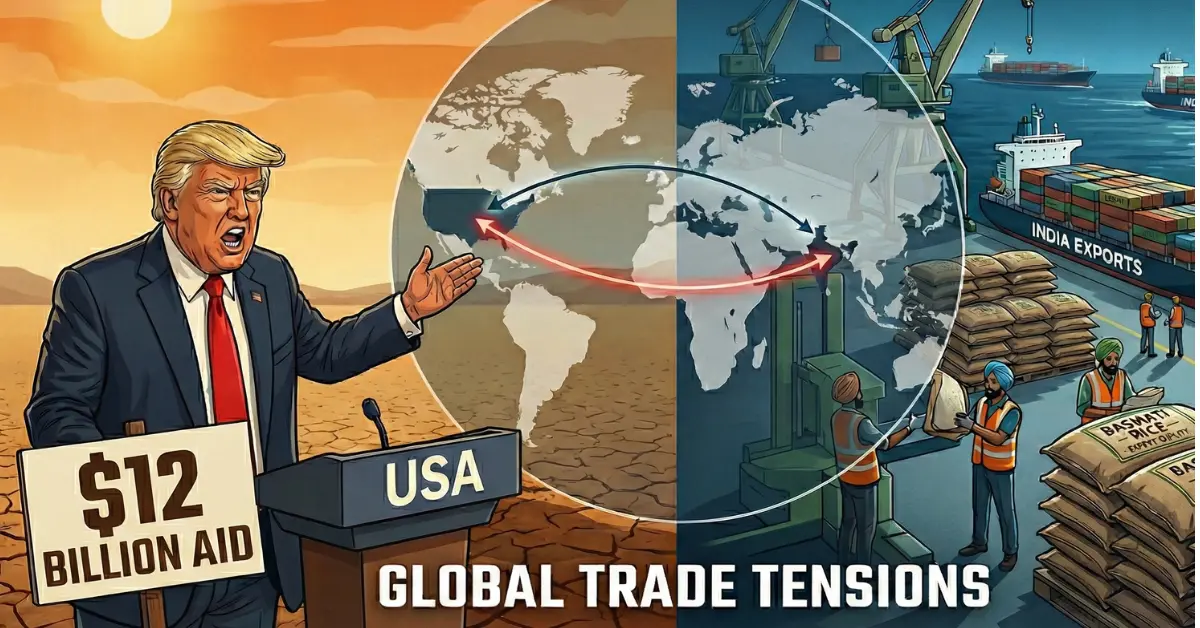
Trump’s $12B farm aid and his warning of tariffs on Indian rice signal a deeper global shift: the U.S. and India are emerging as direct competitors in the battle to feed the world. As American farmers struggle with rising costs and declining exports, India’s rise as a low-cost agricultural superpower—especially in rice, where it dominates 40% of global exports—has triggered new tensions.
The aid-and-tariff combination marks a move toward agricultural protectionism, pushing the two nations into an escalating rivalry with global consequences. If tariffs hit, India could face surpluses that destabilize world markets, while import-dependent regions in Africa and Asia risk price shocks. Both countries are now competing for the same buyers, leveraging subsidies, trade policies, and geopolitical influence.
This emerging “agricultural cold war” could reshape global food security, affect grocery prices, disrupt supply chains, and force nations to rethink how they source the food their populations depend on.
Trump’s $12B Farm Aid Signals a New U.S.–India Agricultural Rivalry With Global Consequences. It begins, as these global reckonings often do, in two places that rarely share a sentence—a drought-stressed soybean farm in Iowa and a humming rice mill in Andhra Pradesh. On one side of the world, American farmers are watching their margins evaporate under the twin heat lamps of rising input costs and shrinking export markets. On the other, Indian exporters—bolstered by cheap labor, aggressive pricing, and a swelling global presence—are bracing for a new threat: tariffs from Washington that could change the direction of global grain flows overnight.
Both groups feel the tremors of something larger, something structural. And when former president Donald Trump announced a $12 billion farm aid package, paired with public warnings of tariffs on Indian rice, it became clear these weren’t isolated political stunts. They were signals.
Signals that two agricultural superpowers—the United States and India—are quietly entering a new era of rivalry, one that could reshape global food security for decades.
This isn’t just policy. It’s the beginning of a global realignment in who feeds the world—and at what cost.
The Spark: Why $12B in Aid and Tariff Threats Matter Now
The $12 billion package—framed as emergency support for struggling American farmers—arrived precisely when many farm families were reaching the brink. Export losses from shifting trade patterns, volatile commodity prices, and higher fertilizer and diesel costs had created a perfect storm. In swing states, the pressure was palpable. Something had to give.
At the same time, the U.S. singled out a surprising target: Indian rice.
India now controls 40% of the global rice export market, a staggering share that has remade food supply chains across Africa, the Middle East, and Southeast Asia. For American producers—already battling Brazil, China, and Australia for agricultural dominance—India’s low-cost surge felt like a direct competitive threat.
When the aid announcement and tariff warning landed almost simultaneously, analysts noticed a pattern: this wasn’t a Band-Aid; it was a strategy.
Strengthen domestic agriculture. Pressure foreign competitors. Reassert U.S. leverage in global grain markets.
A subtle but unmistakable shift toward agricultural protectionism had begun.
The Rise of Two Agricultural Giants :
A. The U.S. Agricultural Machine
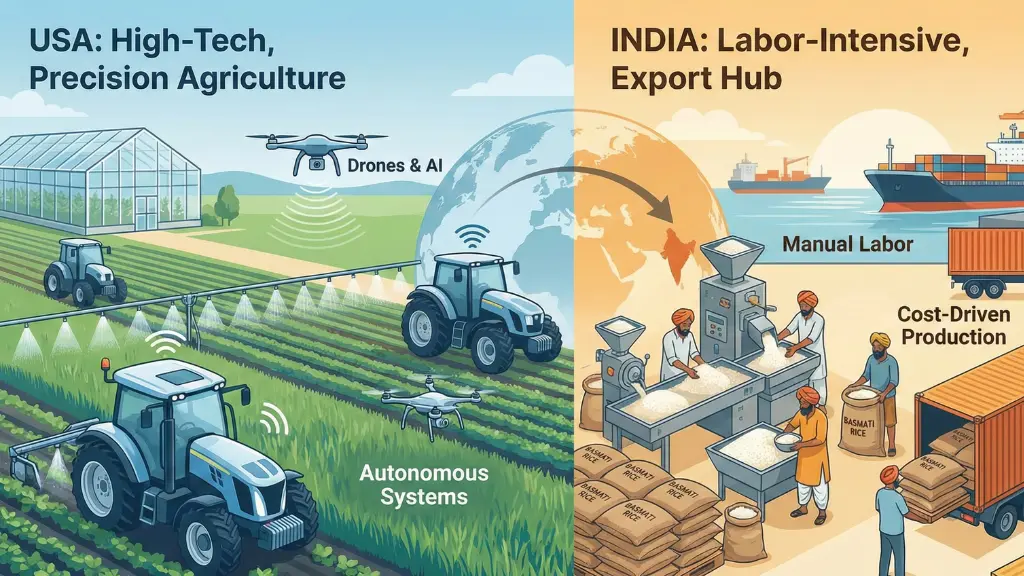
For the United States, agriculture has long been both an economic engine and a geopolitical instrument. The U.S. pioneered large-scale, technology-driven farming—AI-powered tractors, precision irrigation, drone-based yield monitoring—all supported by massive federal subsidies. Farm states are political powerhouses; farm lobbies are among Washington’s most influential.
For decades, the U.S. wielded food exports as soft power: a steady source of stability for allies and leverage over trade rivals. But the world changed faster than Washington expected.
B. India’s Rise as the World’s Food Supplier
India’s ascent is more recent, more dramatic, and far less predictable.
With low production costs, vast arable land, and aggressive investments in irrigation and logistics, India has become a global agricultural force, dominating markets in rice, spices, sugar, wheat derivatives, and processed foods. Government systems like MSP (Minimum Support Price) and export subsidies keep prices low and volumes high.
The result is a head-on collision of capabilities—and competitors.
Here’s a snapshot comparing both agricultural giants:
Table: U.S. vs India — Agricultural Power at a Glance
Factor | United States | India |
Key Strength | Advanced tech & high productivity | Low-cost production & massive labor force |
Primary Exports | Soybeans, corn, wheat, cotton | Rice, sugar, spices, wheat products |
Government Support | Subsidies, crop insurance, relief packages | MSP, fertilizer subsidies, export incentives |
Market Influence | Long-standing global dominance | Rapidly expanding global footprint |
Competitive Edge | Technology & scale | Pricing power & rising global demand |
Core Insight
For the first time in modern history, the U.S. and India are competing for the same buyers, in the same markets, with profoundly different strategies.
That overlap is the true fault line—and it’s widening.
Why the U.S. Now Sees India as a Competitor, Not a Partner
For decades, India was a diplomatic partner, a defense ally, a strategic counterweight to China. But in the commodity markets, goodwill doesn’t always translate into cooperation.
As global grain markets shifted, the U.S. watched its historical dominance in wheat and rice erode. India filled the vacuum, offering cheaper alternatives and capturing emerging markets across Asia and Africa.
American farm lobbies took notice—and began pushing for tariff protections, arguing that Indian imports depressed domestic prices and undermined U.S. rural economies.
Add a presidential election cycle, and the calculus becomes clearer:
- Farm states swing national elections
- Farmers demand relief
- India’s low-cost exports become a political vulnerability
- Tariffs become a campaign-friendly tool
Suddenly, a trade partner becomes a competitor.
A competitor becomes a target.
The Global Food Security Domino Effect
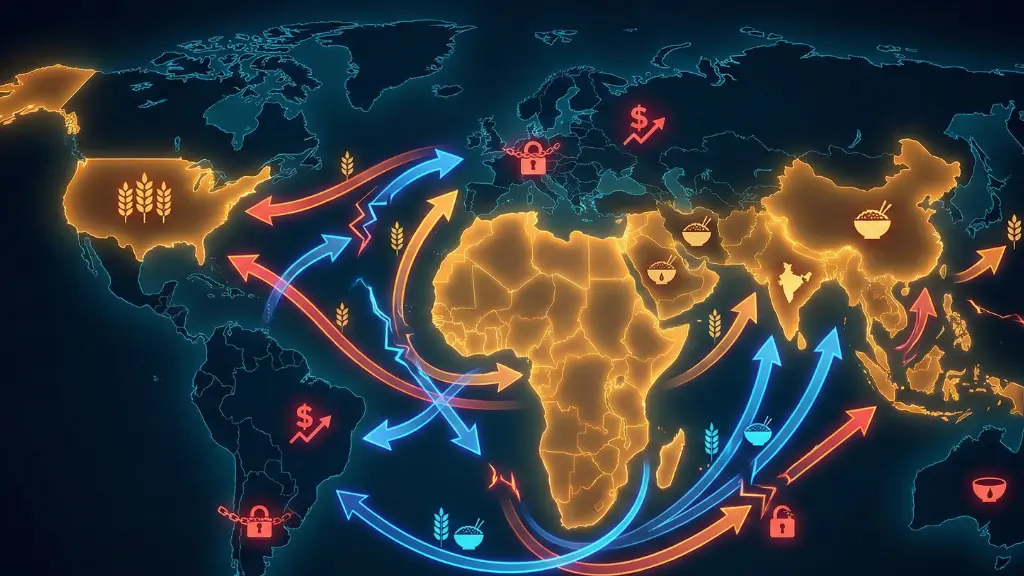
What happens if this rivalry hardens? The first domino is price. Should U.S. tariffs curb Indian rice access to the American market, India could divert more volume to Africa, the Gulf, and Southeast Asia, temporarily pushing prices down but also injecting volatility into markets already wrestling with currency swings and climate shocks. If tensions escalate, India might respond with export bans or stockpile-driven restrictions, moves it has already used in recent years to manage domestic inflation — instantly tightening supply for poorer importers.
Meanwhile, if the U.S. closes more aggressively around its own producers, it could deepen protectionist patterns across other grains, redirecting flows toward aligned trade blocs and leaving non-aligned or low-income nations scrambling for alternatives. Every tariff, every export curb, ricochets through places least able to absorb higher food bills — from Sahelian towns that depend on imported rice to low-income neighborhoods where a few cents on staple foods can tip households into crisis.
Inside this chain reaction, winners and losers emerge:
Group | Likely short-term position |
Heavily subsidized U.S. row-crop farmers | Shielded from shocks, politically empowered |
Indian exporters with diversified markets | Volatile but opportunistic, able to pivot quickly |
Low-income import-dependent countries | Exposed to price spikes, rationing, and supply uncertainty |
Global food aid agencies | Forced to buy less with the same budgets, raising humanitarian risk |
Layer on climate — droughts in India’s northeast, floods in the American Midwest, heatwaves across the global South — and the margin for error in global grain markets shrinks even further.
The New Agricultural Cold War
The phrase may sound dramatic, but the signs are unmistakable.
The battlefields are emerging:
- Export dominance: rice, wheat, pulses
- Subsidy escalation: MSP vs U.S. farm aid
- Trade bloc competition: U.S.–EU vs India–Global South
- Tech vs cost: AI farming vs affordable labor
- Influence campaigns: courting food-insecure regions in Africa & MENA
This isn’t war.
It’s a contest over who gets to feed the world—and under what terms.
Food becomes political currency.
Control becomes power.
How This Affects Everyday People
For Americans
- Grocery inflation could rise as import options shrink
- Rice and specialty crop prices may fluctuate
- Domestic food supply becomes more insulated, but more expensive
For Indians
- Tariffs could lead to temporary rice gluts
- Domestic prices might drop, then surge
- Export bans could protect Indian consumers—but disrupt global buyers
For the World
- Africa and the Middle East remain highly dependent on Indian rice
- Sudden tariff shifts could create humanitarian vulnerabilities
- Global food security becomes sensitive to U.S.–India tensions
This rivalry isn’t abstract. It will show up on supermarket shelves and in family budgets.
What Experts Fear (and Predict)
Agricultural economist Lena Ortiz warns,
“When two major food suppliers collide, it’s not the rivals who suffer first—it’s the nations caught in the middle.”
Food security analyst Rajesh Mendiratta adds,
“A tariff war in grains is far more dangerous than one in steel. You can delay a construction project—you can’t delay hunger.”
Trade diplomat Sarah Kent offers a stark forecast:
“Expect retaliatory tariffs, shifting alliances, and rising pressure on the WTO. The world food system is entering uncharted territory.”
The predictions?
More tariffs.
More volatility.
More geopolitical maneuvering.
And a global grain market on edge.
Is There a Solution?
Avoiding a full-blown food security crisis will require something rarer than subsidies or slogans: genuine coordination. Revamped U.S.–India trade talks could carve out guardrails for agricultural measures, limiting sudden tariffs and designing more predictable pathways for dispute resolution. Both sides could agree on early-warning mechanisms for export bans and stockpile releases, giving vulnerable importers time to adjust.
Beyond diplomacy, diversifying global grain supply — from investing in climate-resilient crops in Africa to backing yield gains in Southeast Asia — would dilute the risk of overdependence on any single exporter. Food security alliances, linking donors, big exporters, and frontline importing countries, could help stabilize emergency stocks and funding when prices spike. And both Washington and New Delhi will eventually have to confront the political addiction to ever-bigger subsidy races, which treat symptoms at home while deepening distortions abroad.
Hope lies in a simple, if demanding, idea: treating food not just as a bargaining chip, but as shared infrastructure for human survival.
A Fork in the Road
The $12B farm aid and tariff threat aren’t mere headlines. They are the opening notes of a longer, deeper shift—one where food becomes geopolitics, where subsidies become strategy, and where two rising powers find themselves competing not in ideology, but in agriculture.
Cooperation or competition?
Stability or volatility?
Shared security or fragmented supply chains?
The answer will shape the plates of billions.
Because when two food superpowers collide,
the world’s dinner table trembles.
FAQ Section
1. Why did Trump announce a $12B farm aid package?
To stabilize U.S. farmers facing export losses, rising input costs, and competitive pressure from low-cost global suppliers like India.
2. Why is the U.S. targeting Indian rice imports?
India’s low-cost rice is undercutting American producers and reshaping global grain markets, triggering political pressure from U.S. farm states.
3. Could tariffs on Indian rice cause global price shifts?
Yes. Tariffs could create Indian surpluses, global volatility, and supply disruptions across Africa and Asia.
4. Is this really an “agricultural cold war”?
Not militarily—but strategically. Both nations are competing for export dominance, influence, and control over global food markets.
5. How will this affect consumers?
Americans may face higher grocery prices; Indian consumers may face volatility; developing nations may see shortages or price shocks.
6. Can the U.S. and India avoid escalation?
Yes—through trade reform, climate resilience investment, and food security cooperation.


Leave a Comment